Outlook
Fashion influencers: planning London Fashion Week briefs
Fashion influencers can plan London Fashion Week briefs by checking booking dates, fees, usage rights, disclosure and delivery deadlines.
What to take away
- London Fashion Week is the trigger that many fashion influencers in London use to set their year, because brand budgets for beauty creator partnerships are planned around the show calendar.
- Backstage beauty content is booked before the shows, often six to ten weeks ahead, and it is usually commissioned as part of a wider seasonal creator brief rather than as a one-off post.
- Agency deal timing runs from show invite to content delivery, and the gap between the two is where most London partnerships are won or lost.
- Usage rights windows are shorter and stricter during fashion week, so creators should agree the licence period, the paid media extension and the territories before they accept a brief.
- The UK regulatory backdrop, including ASA and CMA rules on ad labelling, applies to every backstage post and every paid partnership, whatever the platform.
- A simple checklist before signing a show brief protects both the fee and the content rights.
How London Fashion Week sets the seasonal brief calendar
London Fashion Week runs twice a year, in February and September, and it is the anchor for most beauty and fashion creator briefs in the UK. In recent seasons the main hub has been 180 Strand, with shows from Burberry, JW Anderson, Erdem and Simone Rocha, alongside the BFC Newgen schedule.
Brands and agencies build their beauty creator partnerships around those two moments, then fill the gaps with product launches and always-on content.
LFW seasonal brief calendar
- FebruarySpring/summer campaign briefs
- SeptemberAutumn/winter campaign briefs
- Between peaksProduct launches, always-on content
- Twice yearlyBriefs arrive in clusters
For a London creator, the practical effect is that briefs arrive in clusters, not evenly across the year.
A fashion influencer who wants predictable income should treat LFW as a planning tool, not just a diary date. The brands that book backstage beauty content are usually the same brands that book the surrounding campaign, so one strong show week can lead to a longer partnership.
London is the centre of this activity. Most UK beauty and fashion influencer agencies, brand head offices and creator talent sit in the city, which is why deal flow is denser here than anywhere else in the UK.
A creator based in Manchester or Glasgow can still work the same calendar, but the in-person meetings and show access usually happen in London.
The wider creative economy matters too. UK creative industries statistics cover fashion and creative employment across the regions, from Greater London to the North East. That regional spread is why some briefs now ask for a London creator plus a regional creator in the same campaign.
Before you accept a show invitation, use the channel strategy to shortlist two brands whose products fit your audience and content. Compare their brief timing and rights, prioritise the stronger fit, and decline or defer the rest.
Backstage beauty content: what brands book and when
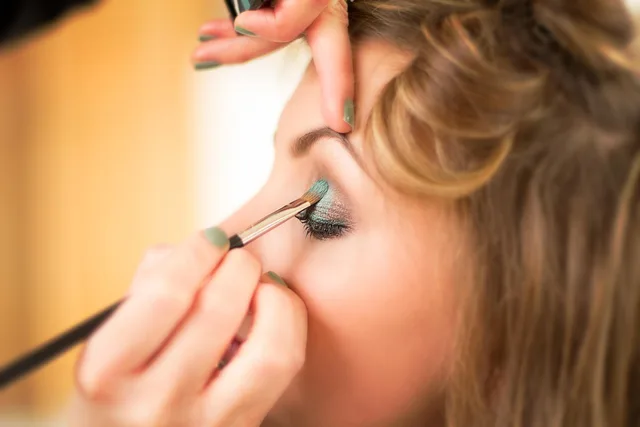
Backstage beauty content is the footage and stills captured in the preparation areas before a show: skin prep, hair styling, nail looks, makeup touch-ups and the final walk-out. Brands book it because it carries proof of professional use without a studio set.
What gets booked most often includes:
- Skin-prep footage and stills
- Hair-styling footage and stills
- Nail-look footage and stills
- Makeup touch-up footage and stills
- Final walk-out footage and stills
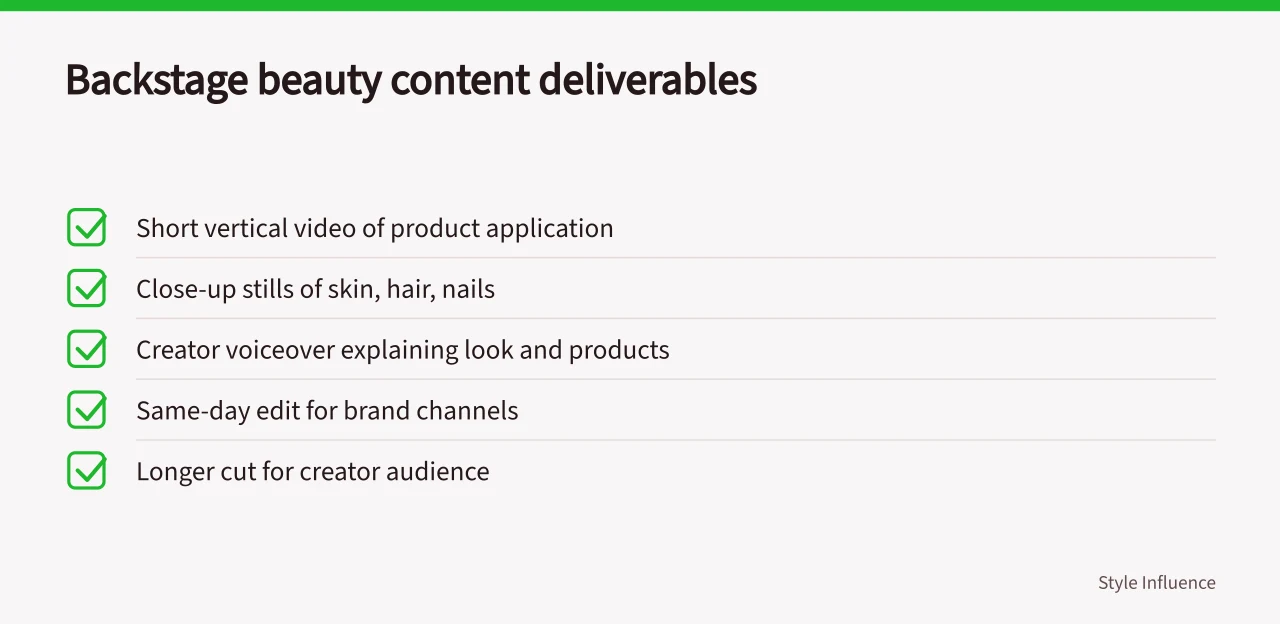
Timing is tight. Most backstage beauty content is commissioned six to ten weeks before the show, when the brand's seasonal creator briefs are signed off. By the week of the show, the slots are usually full.
Brands tend to book two types of creator. The first is the specialist who can talk credibly about formulation, skin prep or hair technique. The second is the audience-led creator whose reach justifies the spend. Some briefs want both in one person, which is rare and priced accordingly.
Brands such as MAC and Charlotte Tilbury have long worked with backstage teams, and agencies including Gleam Futures and Social Chain often sit between the brand and the creator.
There is no published LFW rate card. As a typical benchmark, a single backstage Instagram Reel with a 30-day organic licence often quotes from £750 to £2,500 for a London mid-tier creator. A multi-platform package with paid media can quote £3,000 to £10,000. Fees move with reach, deliverable count, usage window and exclusivity.
For video work, the IAB UK's digital video creative best practice is a useful reference for how branded video should be framed and labelled. It covers the basics that brand legal teams now ask for.
For stills and mixed-format posts, the IAB UK's native distribution creative best practice sets out how branded content should sit natively in a feed without misleading the audience. That matters when a backstage shot looks editorial but is paid.
One warning: backstage access is not the same as a licence to publish everything you see. Unreleased products, other brands' logos and model releases all limit what you can post. Agree the boundaries before the show, not after.
Agency deal timing from show invite to content delivery
Agency deal timing is the sequence that turns a show invitation into a paid, published piece of content. It is not one conversation. It is a series of deadlines, and each one affects the next.
A typical London show brief moves through these stages:
- Receive the show invitation and confirm access and the requested content.
- Agree the fee, deliverables, usage rights, territory, exclusivity and deadlines.
- Review and agree the contract before the shoot.
- Capture the content at the show and submit the first cut by the agreed deadline.
- Get brand approval, publish the content and confirm any paid media use against the agreement.
Show invite to publication
- 8-12 weeks beforeInvitation or access offer
- 4-6 weeks beforeBrief and fee agreed
- 2-4 weeks beforeContract and usage rights signed
- Show windowContent shot
- 24-72 hours after shootFirst cut delivered
- Following weekBrand approval and edits
- Within 2 weeks of showPublication goes live
The approval and publication stage is where most pressure sits. Same-day and next-day edits are common during fashion week, and brands often want approval before the creator posts. If the approval loop is slow, the creator carries the reputational risk of a late post.
A worked example. A London beauty creator is offered a backstage brief for a September show. The fee is agreed six weeks out. The contract arrives four weeks out and includes a 30-day usage window, paid media for 14 days and UK-only territory.
The shoot is on a Tuesday. The first cut is due Wednesday morning. The brand approves on Thursday. The post goes live on Friday. The paid media runs for two weeks after that. Every one of those dates was set before the shoot, which is why the deal worked.
Build a ninety day plan that puts the contract deadline four weeks before the show, so you can negotiate the usage window and paid media dates before the shoot.
Usage rights and turnaround pressure during fashion week
The usage rights window is the period in which a brand can use your content, and on which channels. During fashion week it is the clause most likely to cause a dispute, because the content is time-sensitive and the brand wants to move fast.
Usage rights window trade-offs
Short window
- Duration
- 30 days
- Paid media
- None
- Creator value
- Can be higher
- Fee match
- Licence sets fee
Long all-rights deal
- Duration
- 12 months
- Paid media
- Included
- Creator value
- Often lower
- Fee match
- Licence sets fee
What the window usually covers:
Usage rights and turnaround pressure
- organic posts on the brand's own channels
- paid media, sometimes called whitelisting or dark ads
- the creator's own channels, for an agreed period
- territories, often UK-only but sometimes global
- the right to edit, crop or re-cut
A short window is not automatically bad. A 30-day organic window with no paid media can be worth more to a creator than a 12-month all-rights deal at the same fee. The fee should match the licence, not the other way round.
Turnaround pressure is the other half of this. Brands want content while the show is still being talked about, so edits are fast and approval loops are short. Creators who cannot deliver within 24 to 72 hours should say so before signing, not after.
UK rules apply throughout. The Advertising Standards Authority requires ads to be obviously identifiable, and the Competition and Markets Authority expects paid partnerships to be disclosed clearly. HMRC expects income from these deals to be declared, and the Information Commissioner's Office rules apply if you collect or share audience data. None of that changes because the shoot was backstage.
Before you sign, use a launch review to record the brief in this table. Agree each applicable field in writing before accepting.
Review field / What to confirm
- Fee and deliverables
- The agreed fee and the content to be supplied
- Usage window
- Licence period and channels
- Paid media
- Whether it is included and for how long
- Territory
- Where the brand may use the content
- Turnaround and approval
- First-cut, approval and publication dates
- Exclusivity
- Category, duration and any existing-brand carve-outs
What Londoner creators should agree before accepting a show brief
A show brief is a commercial contract, not a favour. Agree these points in writing before you accept:
- Fee and the content deliverables.
- Usage-rights period, channels and territories, including any paid media extension.
- Exclusivity category, duration and any brands you already work with.
- First-cut, approval and publication deadlines.
- Access and posting boundaries, including unreleased products, other brands' logos and model releases.
- How the partnership will be disclosed as advertising.
Agree before accepting a brief
- Fee, including travel and kit
- Deliverables, formats and counts
- Deadlines, first cut and publication
- Usage rights, channels and territories
- Approval process and sign-off time
- Exclusivity and blocked brands
- Disclosure wording compliant with ASA and CMA
If a brand will not confirm the usage rights window in writing, treat that as a signal. The same applies to exclusivity. A broad exclusivity clause can block other fashion week brand deals for months.
Typical exclusivity windows in beauty creator deals run from 30 days to six months. A 30-day category exclusivity is common for a single show brief. Six to 12 months is a wider brand ambassador term and should carry a higher fee.
To negotiate, narrow the category, start the window on publication rather than signing, and carve out brands you already work with. If the brand wants a long window, ask for a fee uplift or a renewal option.
Keep a simple record of every deal: fee, rights, dates and deliverables. It makes the next negotiation faster and it makes tax reporting straightforward.
A clear strategy and planning guide is worth reading before your next show season, because the calendar repeats and the terms should improve each time.